

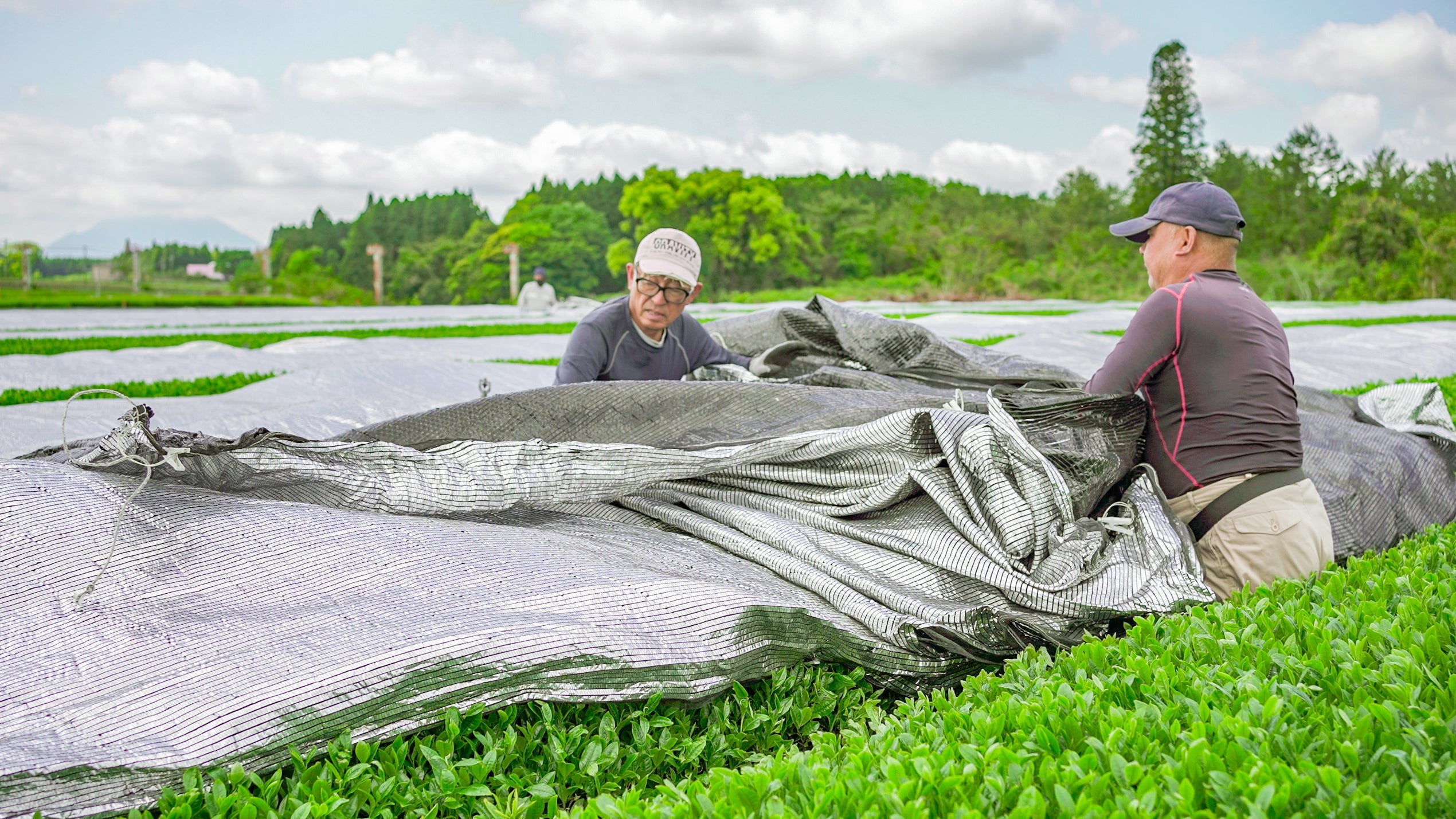
On our tea fields here in Kirishima, as harvest approaches, black covers are spread across the rows. Deliberately blocking the sunlight—a practice that may seem puzzling at first—is called shade cultivation (hifuku saibai), and it is one of the essential techniques of Japanese tea, giving gyokuro and matcha their deep umami. Here, we explain how it works, from the grower's point of view.
What Is Shade Cultivation?
Shade cultivation is a growing method in which, for a set period before harvest, the tea plants are covered with materials such as shade netting to block direct sunlight. Unlike sencha, which is grown in full sun, leaves grown under restricted light become deep in color, tender, and rich in umami. On our own fields, the leaves destined to become matcha are covered for more than 20 days before harvest.
Why Does Blocking Light Increase Umami?
The key is an amino acid called theanine. Theanine is the source of tea's sweetness and umami; it is produced in the roots and carried up to the leaves. When the leaves receive sunlight, theanine converts into catechins, the compounds behind astringency. In other words, the more light the leaves receive, the more astringency develops; the more light is blocked, the more umami remains. Shade cultivation is the technique of holding back this conversion by hand.
- Covering restricts photosynthesis, suppressing the conversion of theanine into catechins
- Seeking what little light there is, the leaves increase chlorophyll and turn a deep green
- The result is a leaf low in astringency and concentrated in sweetness and umami
Gyokuro, Kabusecha, Tencha—Differences in Covering
Teas born from shade cultivation fall broadly into three types. Gyokuro is the finest sencha, carefully shaded for more than about 20 days. Kabusecha is covered for a shorter period of one to two weeks, giving it a flavor between sencha and gyokuro. And tencha is made from leaves shaded as long as gyokuro but then dried without rolling. Grinding this tencha in a stone mill produces matcha.
The Aroma Called Ooika
Shade-grown tea develops a distinctive aroma called ooika (covered aroma), sometimes likened to fresh nori seaweed. It arises as aroma compounds change within the covered leaves, and it is the true identity of that deep, green, sea-like scent you notice when tasting gyokuro or matcha. Covering changes not only umami but aroma—it is a technique that reshapes a tea's character from the ground up.
Our Matcha and Shade Cultivation
At Imamura Tea Plantation, we regard shade cultivation as the foundation of aroma and umami, and use only first-flush spring leaves for our matcha. Our hybrid MATCHA, which combines traditional cultivation with new processing technology, also begins with Kirishima leaves that have quietly gathered umami beneath the covers. You can follow the journey from cultivation to processing in The Making of Tea, and read about the land of Kirishima in What Is Kirishima Tea.
Frequently Asked Questions
Q. How does shade-grown tea differ from ordinary sencha?
It is low in astringency and rich in sweetness and umami. Its color is a deeper green, and it carries the distinctive aroma known as ooika.
Q. Is all matcha shade-grown?
True matcha is made by grinding shade-grown tencha. The length and method of covering vary by region and by maker.




Share:
What is Kirishima Tea? A Guide from a Tea Farmer in Kirishima, Kagoshima
Kagoshima Airport and Imamura Tea Plantation jointly create a boarding pass-shaped organic sencha tea bag — on sale July 16