SOIL PREPARATION

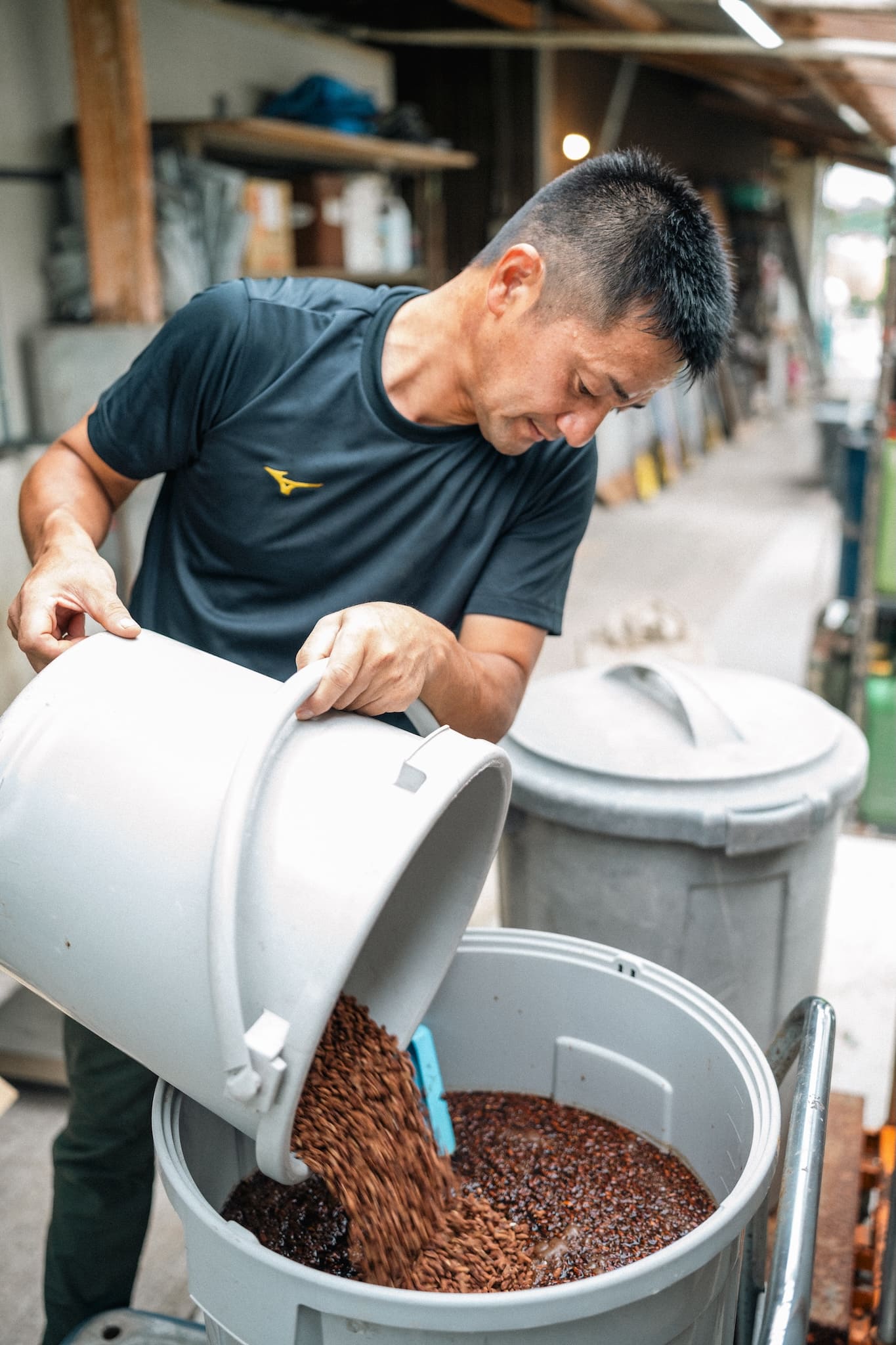
Soil is built, not bought.
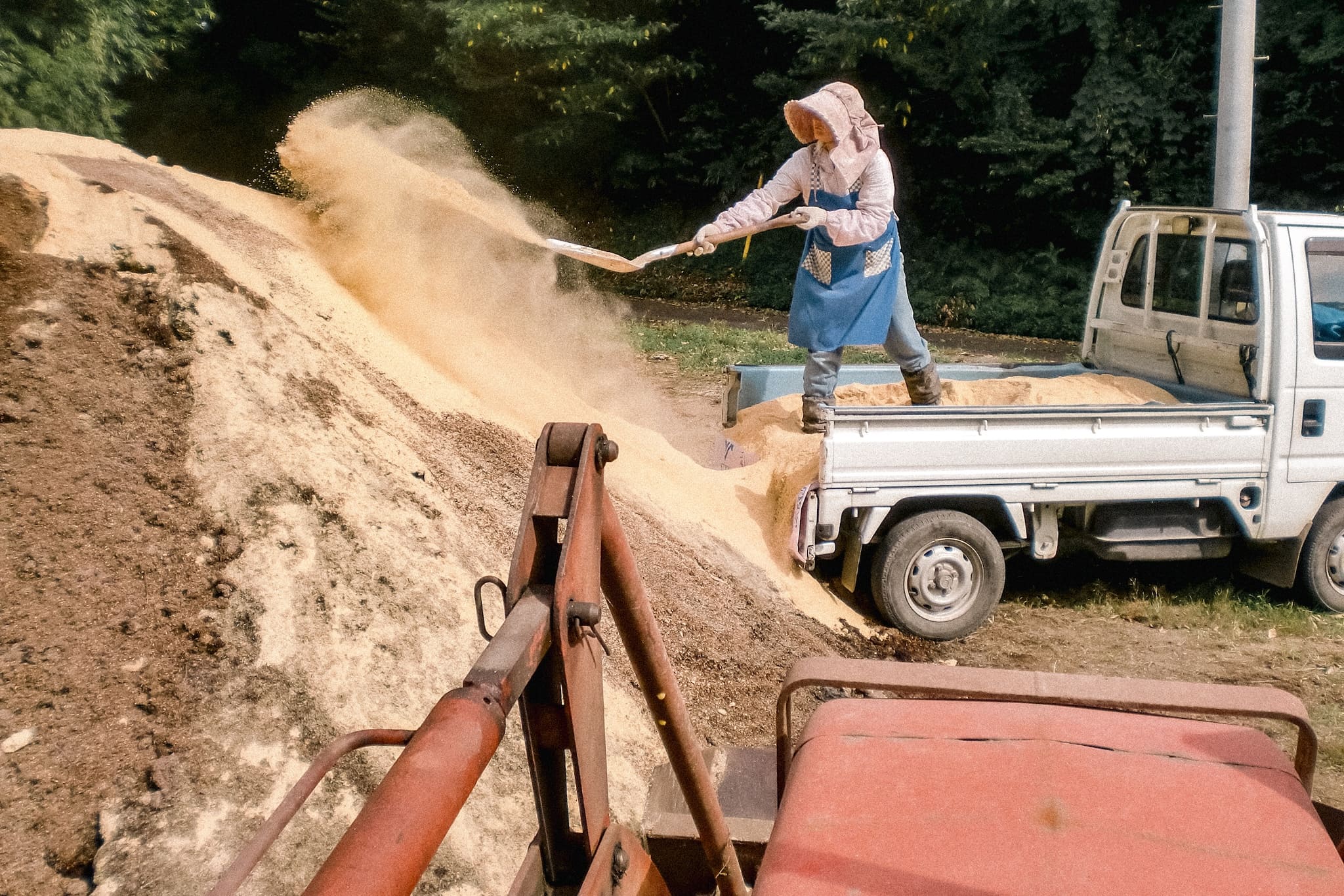
Organic matter—rice straw, fallen leaves, rice husks—
is fermented and broken down by microorganisms.
Some compost piles have been maturing for over twenty years.

土造り

茶づくりは、まず土づくりから始まります。稲わら、落ち葉、籾殻などの有機物を集め、微生物の力で発酵・分解させた土壌改良材をつくります。それをもとに堆肥を仕込み、時間をかけて熟成させます。この堆肥場には、20年以上かけて積み重ねられてきたコンポストもあります。土は毎年つくられ、毎年更新されていきます。ここから、茶樹を支える基盤が整えられます。

Compost is layered and turned over time.
Heat rises from within as microorganisms work unseen.
Each year the soil is renewed, strengthening the roots that will sustain the tea.

動画を読み込む

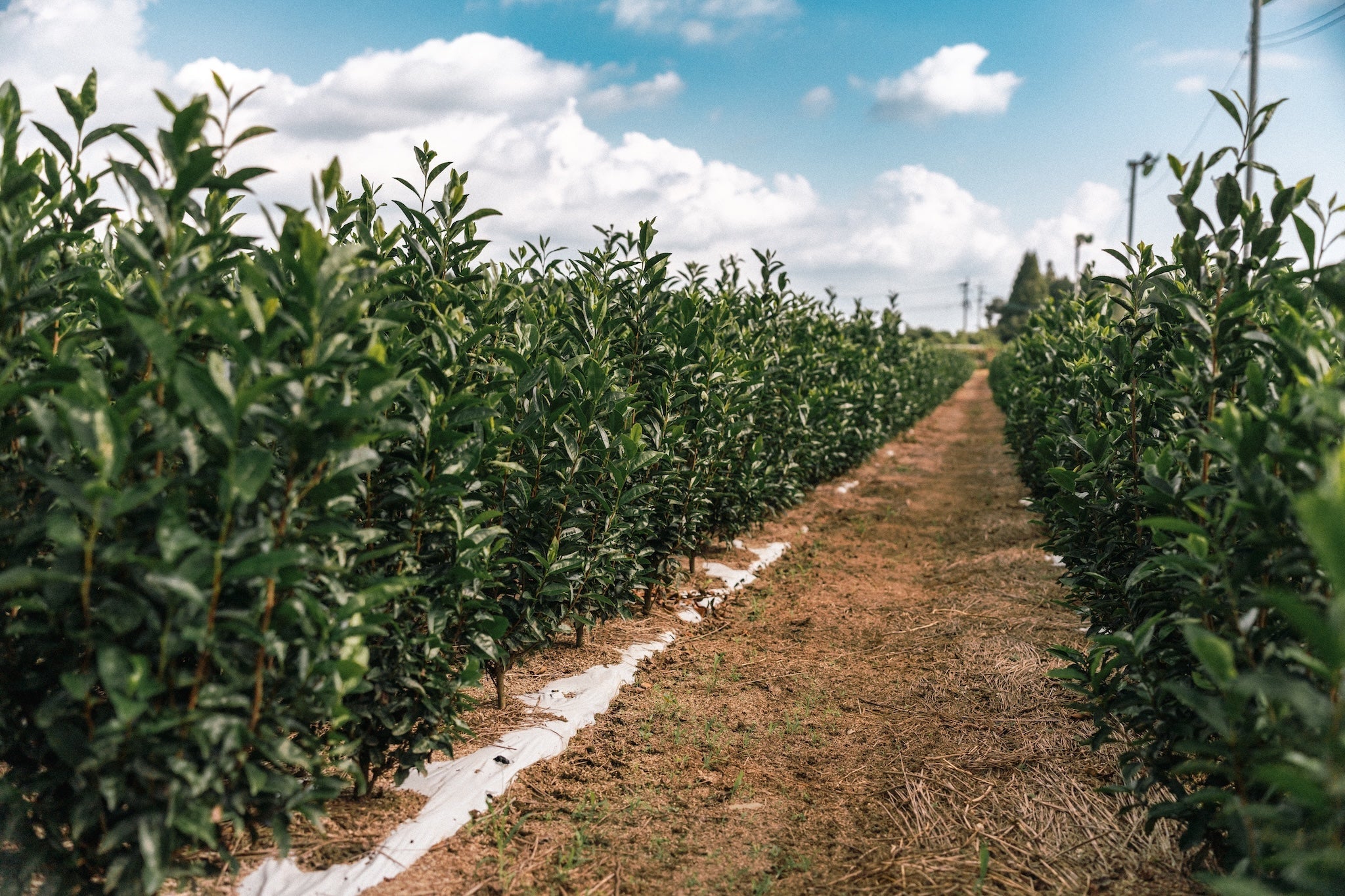
Transplanting

Tea cultivation begins with planting young saplings in carefully spaced rows.Roots are allowed to establish firmly. Through pruning and steady care, the trees are shaped over several years.They are strengthened to produce consistent, healthy shoots.

定植

茶樹は、苗木を一本ずつ畑に植えることから始まります。間隔や列の向きを整え、根がしっかり張る環境をつくります。植え付け後は、水分管理や除草、剪定を行いながら、樹形を整えていきます。数年をかけて枝葉を充実させ、安定して芽を出せる状態へと育てます。こうして整えられた茶樹が、その後の収穫を支える土台となります。

Compost is layered and turned over time.
Heat rises from within as microorganisms work unseen.
Each year the soil is renewed, strengthening the roots that will sustain the tea.

動画を読み込む

ORGANIC PRACTICE

Organic cultivation here is not an absence of chemicals.
It is a system built through fermentation.
Microorganisms are cultivated, not suppressed.
Materials are transformed, not applied.
The field is treated as a living environment.

有機栽培

私たちの有機栽培は、単に化学農薬を使わないという意味ではありません。発酵を軸とした設計そのものです。廃糖蜜と酵母からアルコールを起こし、米麹で酵素を抽出します。そこにニームの実を加え、時間をかけて発酵・熟成させます。さらに米糠や麹菌を組み合わせ、微生物が働く環境を整えます。畑は管理する対象ではなく、生きた環境として扱います。制御するのではなく、バランスを整える。時間を味方につける栽培です。

霧茶人|有機煎茶 - 今村茶園

Our fully organic protective solution is crafted entirely by hand, from the ground up.
Neem—derived from the Indian chinaberry tree—is combined with familiar local ingredients such as koji cultures and molasses, and shaped through the power of fermentation.
The unseen work of microorganisms cultivates the environment itself, protecting the tea before the leaves even grow.

動画を読み込む

MANAGEMENT

Winter is not a pause. It is preparation. Fertilization continues to strengthen the roots. Nutrients are adjusted to prepare the trees for spring. When frost threatens, water is sprayed deliberately. As it freezes, it releases latent heat, keeping the buds at 0°C. Fans move the cold air. Ice becomes protection. The buds sleep. Spring waits.

冬を越すために

冬は休止期間ではありません。春への準備の時間です。根を強くするための肥培管理は続きます。春の芽吹きに備え、栄養バランスを整えます。霜の恐れがある夜、あえて水を散布します。水が凍る際に発生する凝固熱により、芽の温度は0℃に保たれます。防霜ファンが冷気を動かします。氷は防御へと変わります。芽は眠り、春を待ちます

After planting, the young trees are protected through their first winter.
Rice husks are spread across the soil to retain warmth and suppress weeds.
This simple layer stabilizes temperature and reduces competition from surrounding growth.
Growth continues quietly beneath the surface.

動画を読み込む

HARVEST

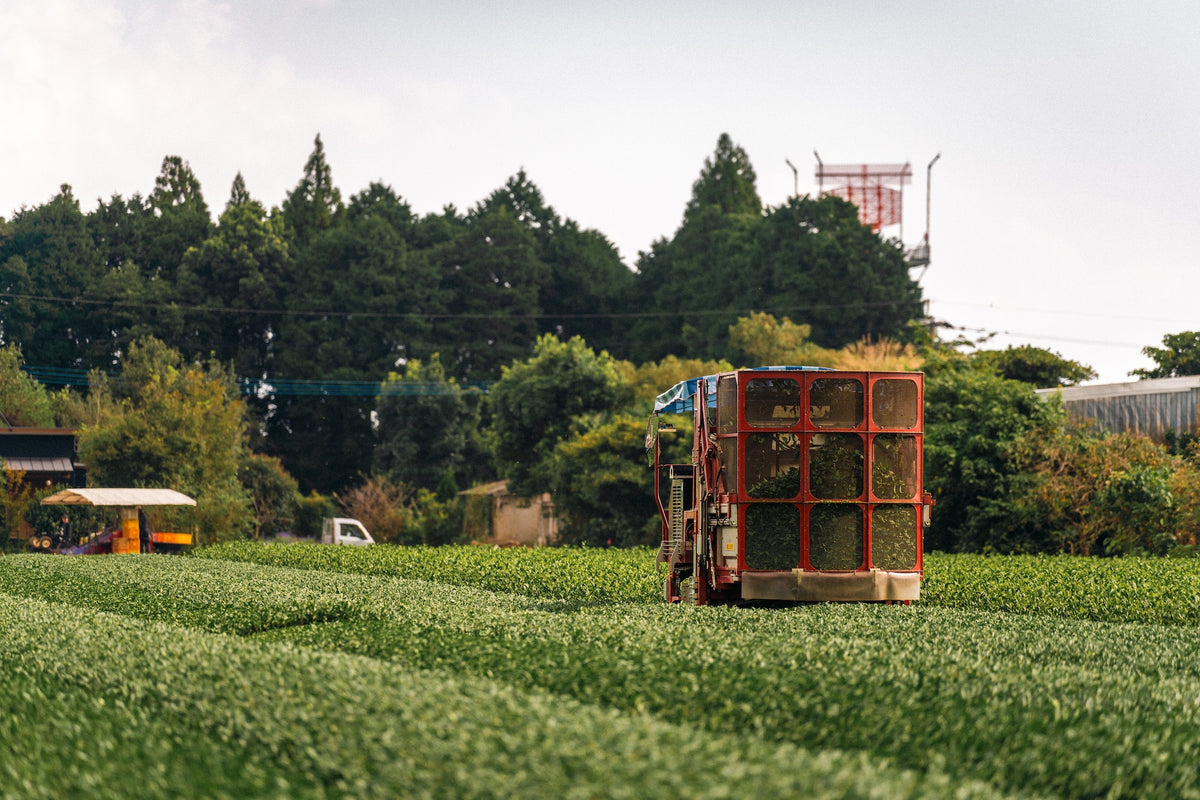
When spring arrives, the dormant tea bushes burst into life all at once. The buds that endured the cold now carry deep reserves of umami, growing steadily toward harvest. In the weeks before picking, the fields are covered with shade canopies, softening the direct sunlight. By reducing light exposure, the leaves grow slowly, accumulating richness and sweetness. Combined with the climate of Kirishima, the texture and fragrance of each leaf is refined even further.

収穫

春になると、眠っていた茶葉が一斉に芽吹きます。寒さを越えた芽は、旨味を蓄えながら成長し、やがて収穫の時を迎えます。収穫前の一定期間、茶畑を覆い、直射日光をやわらげる被覆栽培を行います。光を抑えることで、茶葉はゆっくりと成長し、旨味や甘みを蓄えていきます。霧島の気候と組み合わせることで、葉の質感と香りがより整えられます。

収穫には、茶葉の状態を見極めながら刈り取る適採機を使用します。
芽の位置や高さを揃え、葉を傷めないように調整しながら進めることで、
その後の製造工程につながる均一な原葉を確保します。

動画を読み込む

MANUFACTURING

The moment a leaf is picked, it has already begun to change.

Manufacturing is the art of guiding that change. Steam, roll, dry — within these seemingly simple acts lies a precise accumulation of judgment, coaxing out aroma, color, and depth from the leaf.

When two generations of engineers turned their eyes toward tea, the manufacturing process was reborn through the lens of engineering.

By the time the leaf becomes tea, it has passed through many hands, many decisions, many transformations.

製造

茶葉は、摘み取られた瞬間からすでに変わり始めています。

製茶とは、その変化をコントロールする技術です。蒸し、揉み、乾かす——繰り返されるシンプルな動作の中に、香り・色・旨味を引き出すための緻密な判断が積み重なっています。

エンジニアが、その目をお茶づくりに向けたとき、製茶工程はエンジニアリングの視点で再解釈されました。

一杯のお茶に至るまでに、茶葉はいくつもの手と機械を経て、その姿を変えていきます。

2025 First Flush / Kirishima Green Tea / Kagoshima Tea - 今村茶園

収穫には、茶葉の状態を見極めながら刈り取る適採機を使用します。
芽の位置や高さを揃え、葉を傷めないように調整しながら進めることで、
その後の製造工程につながる均一な原葉を確保します。

Primary Tea Processing

荒茶製造
From the moment the leaves are harvested, time becomes critical.
Heat, pressure, and airflow work in precise sequence to preserve color, aroma, and structure—transforming fresh leaves into raw tea.

動画を読み込む

Post-Harvest Handling

茶畑から茶工場へ

The moment a new bud is picked, oxidation begins. Aroma and flavor start to shift — slowly, but immediately.

To preserve that quality, the leaves are transported to the factory without delay, moving seamlessly into the next stage of processing.

The field and the factory are not separate places. They are one continuous process.

This swift transition is what sustains the quality of everything that follows.

動画を読み込む

Fresh Leaf Management

生葉管理

After harvest, the fresh leaves are held in specialized mesh-bottom containers that allow air to circulate from below. This maintains humidity and keeps the leaves close to their just-picked condition.

The state of the fresh leaf determines the quality of everything that follows. No amount of skill in processing can produce tea that surpasses the quality of its raw material.

Every step from this point forward is built on the foundation laid here.

動画を読み込む

Steaming process

蒸熱

Steaming is the step that defines the color, flavor, and aroma of the tea. A difference of just a few seconds changes everything — the taste, the fragrance, the clarity of the brew.

By halting oxidation at this stage, the vivid green of the leaf is locked in and unwanted grassy notes are removed. For sencha, steaming typically lasts around 30 seconds. Longer steaming brightens the color and softens the astringency, while also making the leaf cells more delicate — resulting in a slightly cloudier infusion.

Steaming is the foundation of Japanese green tea. It sets the character for all that follows.

動画を読み込む

ORTHODOX METHOD / ROTARY VANE

オーソドックス製法 / ローターバン

Before moving to the leaf-beating and primary rolling stages, the steamed leaves pass through a machine called a rotorvane — a continuous rolling device developed in India in 1958, originally used in the production of orthodox black tea.

At Imamura Tea Plantation, this step has been incorporated into our green tea processing line. As the leaves pass through the rotating cylinder, stems and leaves are gently worked together, creating a more uniform structure that allows flavor compounds to be extracted more evenly.

The result is improved color clarity and consistency in the brew — and a more unified character across the entire leaf.

動画を読み込む

Rough kneading

葉打ち・粗揉

Immediately after steaming, the leaves are cooled to preserve their flavor and aroma. Left at high temperature, quality would quickly deteriorate.

In the leaf-beating stage, dry hot air is blown through the leaves while pressure is applied, removing the residual moisture from the steaming process. This stabilizes color and aroma, and prepares the leaves for primary rolling.

Primary rolling then uses strong pressure and hot air to draw out moisture evenly. The process requires precision — the leaves must be kept at around 36°C, close to body temperature. At our plantation, we operate six machines for these two stages, adjusting each according to the condition of the leaves on the day.

動画を読み込む

Kneading

揉捻

Rolling applies pressure to the leaves, distributing moisture and flavor compounds evenly throughout. It follows primary rolling, evening out any remaining inconsistencies in moisture and loosening the cellular structure so that umami can be more readily extracted during brewing.

No heat is applied in this stage. The leaves are gathered into a single mass and worked with varying degrees of pressure.

The way the leaves are rolled here directly shapes the aroma, flavor, and overall character of the finished tea.

動画を読み込む

Medium kneading

中揉

After rolling, the leaves still carry significant moisture and are uneven in shape. Intermediate rolling addresses this in two distinct stages.

In the first stage, dry hot air and pressure are applied simultaneously, removing a large portion of the remaining moisture. The second stage uses a different drying method to bring the moisture content to a more uniform level.

A rotating drum with internal pressing action works efficiently to draw out moisture under consistent pressure. By the end of this process, the leaves are ready to enter the final rolling stage.

動画を読み込む

 Final Rolling

精揉

Final rolling dries the leaves while shaping them into the fine, needle-like form characteristic of Japanese green tea. The base of the machine is heated with gas, and the leaves are pressed and worked in a motion that replicates the movement of human hands.

The rolling action moves like a pendulum around a central axis, finishing with weighted pressure applied to tighten the leaf. A large rotating brush then passes over the leaves as the tray moves, ensuring an even, consistent roll throughout.

By the end of this stage, the leaves have achieved their form, their moisture level, and their texture — the distinctive beauty of Japanese tea, fully realized.

動画を読み込む

Drying

乾燥

After final rolling, the leaves undergo a finishing dry. Moisture content is reduced from approximately 10–13% down to around 5% — the level required for long-term storage.

From the fresh leaf, which contains 70–80% moisture, to this point — the water has been methodically removed at every stage.

With this, the aroma stabilizes and the aracha — the unrefined tea — is complete. This marks the end of the primary processing phase.

動画を読み込む

Sifting

篩がけ

From here, the finishing begins.

Using a sequence of graded screens, the leaves are sifted by size and shape. With each pass, variation is reduced and the tea moves toward a more uniform form.

Finer meshes isolate honcha — the most desirable portions — though yield decreases. Wider meshes preserve volume, allowing a broader range of leaf character to remain.

This stage balances quality and quantity. By adjusting the mesh and sequence, the leaves are refined for consistency, ensuring stable aroma and flavor in the cup.

動画を読み込む

Color selection

色彩選別

Each leaf is scanned by high-precision CCD cameras, detecting what the human eye cannot — fine fiber, small stems, red stems, microscopic foreign matter — and removing them instantly.

The leaves flow across an angled, flat surface, allowing every form of tea to pass through with equal precision: finished tea, aracha, tencha, fukamushi. What has been built through human skill and judgment is protected, at this final stage, by machine.

動画を読み込む

Blending

合組

Blending is the craft of bringing different tea leaves into harmony.

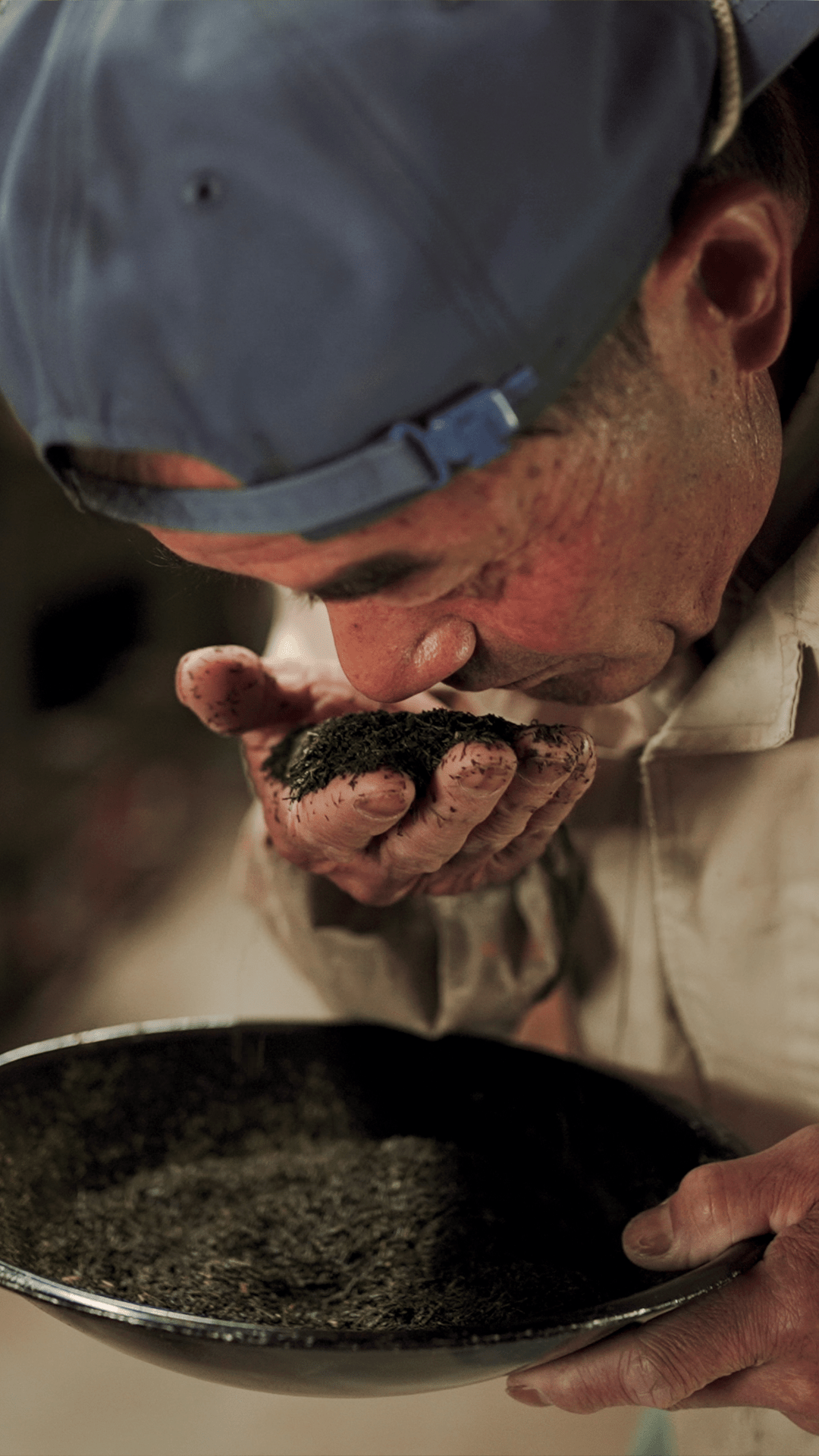
Variety, steaming level, and individual character are carefully assessed, using sight, aroma, taste, and touch.

This process requires experience and refined judgment, and plays a vital role in shaping the final cup.

Through blending, each element is balanced, allowing the tea to express a unified flavor greater than any single leaf alone.

動画を読み込む

Packaging

袋詰め

Once complete, the tea is packaged immediately to preserve its quality. Aracha and finished tea are sealed in 30kg bags; matcha and retail products are packaged to their respective specifications. Each package is nitrogen-flushed to prevent oxidation and maintain freshness through shipping.

From here, the tea moves to the Kagoshima market and to buyers around the world. The journey that began in the field reaches its completion here.

動画を読み込む

ROASTING

Fire finishing is the final conversation between the maker and the leaf.

Not a fierce flame, but a slow, gentle heat — drawing out moisture, coaxing the fragrance and sweetness from deep within the leaf. This quiet warmth brings what has been sleeping inside the tea to the surface.

A slight difference in temperature, a moment's difference in time — and the character of the tea shifts entirely. Too much heat, and the aroma vanishes. Too little, and the afterglow never comes.

That lingering sensation you feel after the last sip — it is born here.

焙煎

火入れは、お茶の仕上げにおける最後の対話です。

強く焦がすのではなく、低温の熱をゆっくりと加えながら、余分な水分を取り除き、茶葉の香りと甘みを引き出していきます。この穏やかな熱が、茶葉の奥に眠っていた風味を、そっと表へと連れ出します。

温度と時間の加減はわずかな差が仕上がりを変えます。強すぎれば香りは飛び、足りなければ余韻は生まれない。

一杯のお茶を飲み終えた後に残るあの余韻は、ここで生まれています。

収穫には、茶葉の状態を見極めながら刈り取る適採機を使用します。
芽の位置や高さを揃え、葉を傷めないように調整しながら進めることで、
その後の製造工程につながる均一な原葉を確保します。

Cycle

In the course of production, some leaves fall from the line or scatter during transport. None of them are discarded. They are returned to the field. For the tea plant, the finest fertilizer is tea itself. Not a single leaf is wasted. Everything returns to the soil.

循環

生産や製造の過程では、ラインから外れてしまう茶葉や、搬送中にこぼれ落ちる茶葉が生まれます。それらを捨てることはありません。再び畑へと還します。茶にとって、最も良い肥料は茶そのものだからです。一枚たりとも無駄にせず、すべてを土へ戻します。

Compost is layered and turned over time.
Heat rises from within as microorganisms work unseen.
Each year the soil is renewed, strengthening the roots that will sustain the tea.


Highlights


In 2024, Kagoshima Prefecture produced approximately 27,000 tonnes of aracha — unrefined tea — claiming the top position in Japan for the first time since records began in 1959. For decades, that place had belonged to Shizuoka. In 2025, production exceeded 30,000 tonnes, holding the top rank for a second consecutive year.

200,300

Plantation’s total field area

1st

Kagoshima’s rank

30,000t

Kagoshima’s raw tea output

44%

Third harvest production

This achievement was not made by Kagoshima alone. It stands on the accumulated knowledge and craft of tea producers across Japan — generations of growers who shaped what tea-making in this country has become.

At Imamura Tea Plantation, we tend to each leaf with the same care that this land and its history demand. Rooted in Kagoshima's nature and the tea culture passed down through time, we continue — quietly, steadily — moving toward the next era of what this place can become.


CERTIFICATIONS

認証

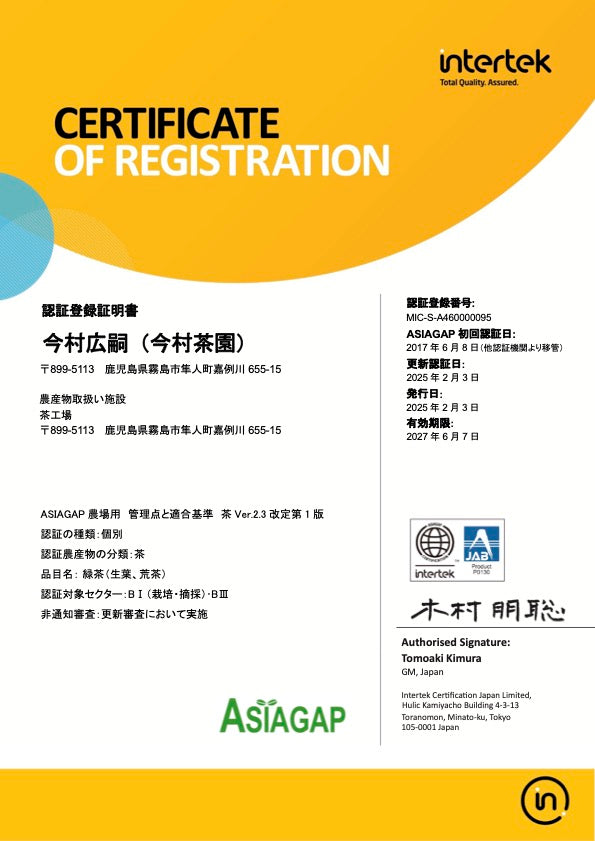
Imamura Tea Plantation holds both ASIAGAP and Organic JAS certification.
Each represents an independent, third-party recognition of our commitment to responsible farm management, environmental care, and consistent quality.
To honor the nature of Kirishima — and to deliver a cup you can trust. Certification is one form that promise takes.

ASIA GAP

CERTIFICATE OF REGISTRATION
Certification Number: MIC-S-A60000095

  • Standard
    Farm Management and Compliance Standard for Tea, Version 2.3 (Revised Version 1)
  • Certification Type
    Individual Certification
  • Product Category
    Tea
  • Products
    Green Tea (Raw Leaves, Unrefined Tea)
  • Certified Scope
    BI (Cultivation and Harvesting)
    BIII (Processing)
Organic Agricultural Product Process Manager

Certification Number: 1097

  • Type of Agricultural Products Subject to Certification
    Organic Agricultural Products
  • Legal Basis for Certification
    Act on Japanese Agricultural Standards (Act No. 175 of 1950)
  • JAS Standards for Certification
    Japanese Agricultural Standards for Organic Agricultural Products
  • Technical Standards for Certification
    Technical Standards for Certification of Organic Agricultural Products and Organic Feed (limited to those that have introduced processes such as sorting or selection only) for Production Process Managers and Overseas Production Process Managers
Organic Processed Food Production Process Manager


Certification Number: Processing 1108

  • Type of Agricultural Products Certified
    Organic Processed Foods
  • Legal Basis for Certification
    Act on Japanese Agricultural Standards (Act No. 175 of 1950)
  • JAS Standards for Certification
    Japanese Agricultural Standards for Organic Processed Foods
  • Technical Standards for Certification
    Technical Standards for Certification of Organic Processed Foods and Organic Feed (limited to those that have introduced processes such as sorting or selection only) for Production Process Managers and Overseas Production Process Managers

ASIAGAP is a farm management certification program approved by the GFSI (Global Food Safety Initiative) — the internationally recognized body supported by the world's leading food companies and retailers.

Certification confirms that Imamura Tea Plantation meets rigorous standards across food safety, environmental management, worker safety, human rights, and farm operations — all verified by an independent third-party auditor.

For importers, ASIAGAP certification provides documented assurance of responsible agricultural practice, supporting compliance with international food safety requirements at the point of customs clearance.

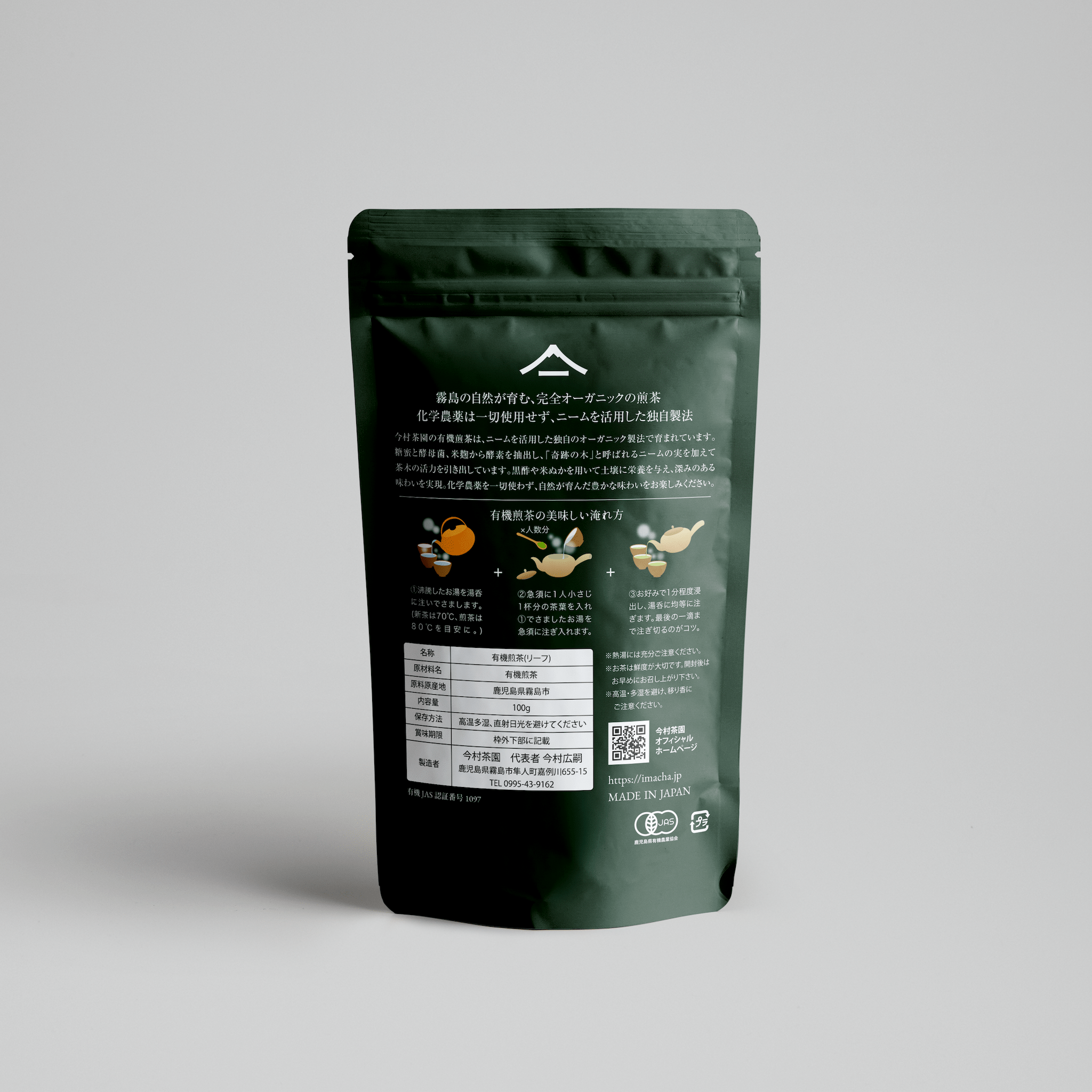
Organic JAS is Japan's national certification for organic agricultural products, administered by the Ministry of Agriculture, Forestry and Fisheries. It certifies that our tea is produced without the use of synthetic pesticides or chemical fertilizers, under strict and independently verified standards.

Critically for international buyers: Japan's Organic JAS certification holds mutual equivalence recognition with the USDA National Organic Program (NOP). Products certified under Organic JAS may be sold as organic in the United States without requiring separate USDA certification. Equivalence has also been recognized with EU organic standards.

For importers, this means reduced certification barriers and a clearer path to market — backed by one of the most stringent organic standards in Asia.


Brand concept


Our concept, "I want the afterglow of Kirishima to linger on."
comes from a simple wish.

The memories you carry from visiting Kirishima—
the wind of Kagoshima, the warmth of its people,
the feeling of being welcomed by a gentle hometown.

Moments when you think of your family,
your loved ones,
or someone you wish to reach out to.

In those quiet, nostalgic moments,
we hope that a cup of Imamura Tea
will let you feel that afterglow once again.

We are committed to sharing the beauty of Kirishima tea
and the richness of its natural landscape
with people all around the world.

Like the resonance after a bell is struck,
the sound fades, but something still lingers in the air.
We call that yoin — the afterglow.


About This Project

Company

IMAMURA TEA PLANTATION
Established 1970

Address

655-15 Karegawa, Hayato-cho, Kirishima-shi, Kagoshima 899-5113 Japan

Contact Information

Tel 0995-43-9162
Fax 0995-43-9260

Hours of Operation

10:00 – 17:00
Closed on Sundays and National Holidays

Tea Master:Hirotsugu Imamura

When I face the craft of tea, I always hold on to a sense of “freedom.”I listen to the voice of nature, break away from fixed forms, and quietly explore the possibilities within each cup.

Producer:Yoshihiro Shimazu

Tea takes me places I never expected—beyond landscapes, beyond time, and sometimes even beyond myself.It keeps leading me forward, and I keep following.

Branding:I.T.P.entertainment

We deliver emotion through stories and tea, crafting moments that stay with you.

Certifications & Qualifications

有機JAS農産物生産工程管理者 認証番号: 1097
有機JAS加工食品生産工程管理者 認証番号: 加工 1108
ASIAGAP 認証登録番号:MIC-S-A460000095

Imamura Tea Plantation – ASIAGAP Certified Farm, Reg.A460000095, Kirishima Kagoshima Japan
Imamura Tea Plantation – Organic JAS Certified by Kagoshima Organic Agriculture Association, Kirishima
Imamura Tea Plantation – Kagoshima Prefectural Tea Association Chairman's Award, Kirishima
Imamura Tea Plantation – Kyushu Agriculture Director's Award, Kagoshima Prefectural Tea Evaluation
 

PRESENTED BY

IMAMURA TEA PLANTATION

© all rights reserved

I want the afterglow of Kirishima to linger on.